You know that feeling when you're lined up on a critical 8-ball, the pressure is on, and you need just a touch of outside english to avoid scratching in the side pocket? That is the moment where your equipment stops being just a stick and starts becoming an extension of your arm. For years, I've told players that the arrow matters almost as much as the archer, especially when you are trying to break through a plateau in your skill development.
Lately, the biggest debate in the pool hall hasn't been about rules or racks; it's been about materials. Do you stick with the organic, traditional feel of maple wood, or do you make the leap to the consistency of carbon fiber? It used to be that carbon fiber was reserved for players with deep pockets, but the market is shifting. Today, we are looking at two cues that are shaking up the entry-to-mid-level market: the CUESSIR Ascend Carbon Fiber Pool Cue and the CUEELF Professional Pool Cue.
I have spent considerable table time with both of these cues. The CUESSIR represents the new wave—affordable aerospace-grade technology designed to minimize deflection. The CUEELF represents the refined traditionalist—a solid wood construction with premium touches like a leather grip and a phenolic ferrule. If you are sitting on the fence between trying new tech or upgrading your traditional gear, this head-to-head comparison is exactly what you need.
Our Top Pick

CUESSIR
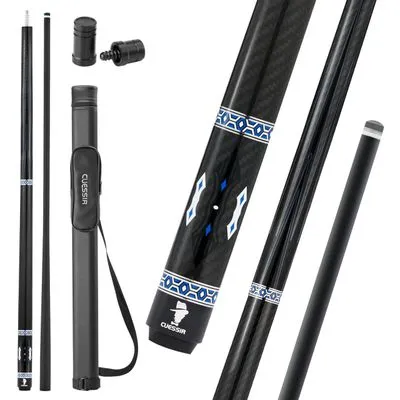
CUESSIR Ascend Carbon Fiber Pool Cue 58"
Best Overall:
The CUESSIR Ascend takes the win for pure performance-per-dollar. Getting a true low-deflection carbon fiber shaft at this price point is frankly hard to beat. It offers better durability and consistency for players learning to use spin.
| Feature | CUESSIR Ascend Carbon Fiber | CUEELF Professional |
|---|---|---|
| Shaft Material | Aerospace-grade Carbon Fiber | Hardwood (Maple) |
| Price | $119.99 | $149.90 |
| Tip Diameter | 12.5mm | 12.5mm |
| Tip Type | 6-Layer Pigskin Leather | 6-Layer Performance Tip |
| Joint | 3/8x8 Stainless Radial | 3/8x8 Stainless Radial |
| Grip | Smooth/Carbon Texture | Premium Leather Wrap |
| Weight | 19-20oz (Adjustable) | 20oz |
| Ferrule | Integrated/Carbon | Phenolic |
| Deflection | Low | Standard-to-Low |
| Extras | Hard Case Included | Extension Compatible |
CUESSIR Ascend vs CUEELF Professional: Shaft Technology and Deflection
Let's get right into the meat of the discussion: the shaft. This is the engine of the pool cue. It is where the energy transfer happens and where accuracy is either won or lost.
The CUESSIR Carbon Advantage
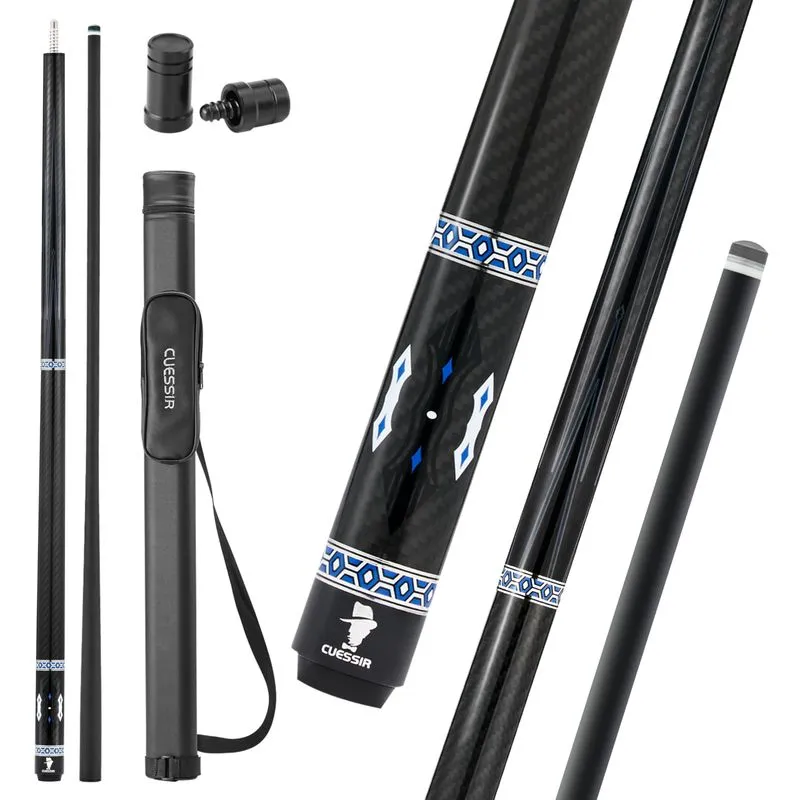
The CUESSIR Ascend features an aerospace-grade carbon fiber shaft. If you have never shot with carbon, the first thing you will notice is the stiffness. Carbon fiber is significantly more rigid than wood. When you strike the cue ball, especially on power shots, the shaft doesn't buckle or vibrate in the same way wood does.
The CUESSIR utilizes a 3K carbon fiber weave. In my testing, this resulted in very low deflection (squirt). When I applied heavy right-hand english, the cue ball squirted less to the left than it would with a standard maple shaft. This means you don't have to compensate your aim as much when using spin. For an intermediate player learning the complexities of position play, this is a massive benefit. The energy transfer is instantaneous. You hear a distinct "tink" sound, and the ball moves immediately.
Another aspect of the CUESSIR shaft is the "pro taper." It stays the same diameter for a longer distance from the tip back towards the joint before it starts to widen. This allows you to bridge at different lengths without the cue rising or falling in your fingers. The smooth, matte finish of the carbon fiber also glides through an open bridge effortlessly, even in humid conditions where wood might get sticky.
Watch: CUESSIR Ascend Carbon Fiber Pool Cue 58"
The CUEELF Wood Construction
The CUEELF Professional, on the other hand, relies on traditional wood construction. While the specifications mention "low deflection technology," it is important to manage expectations. A solid wood shaft, by nature of its mass at the front end, will generally have more deflection than a hollow or foam-filled carbon shaft.
However, CUEELF has mitigated this by using a phenolic ferrule. Phenolic resin is lighter and harder than standard plastic ferrules, which reduces the end mass slightly and provides a very solid hit. In my drills, the CUEELF performed admirably for a wood cue. It didn't have the laser-like stiffness of the CUESSIR, but it had "life."
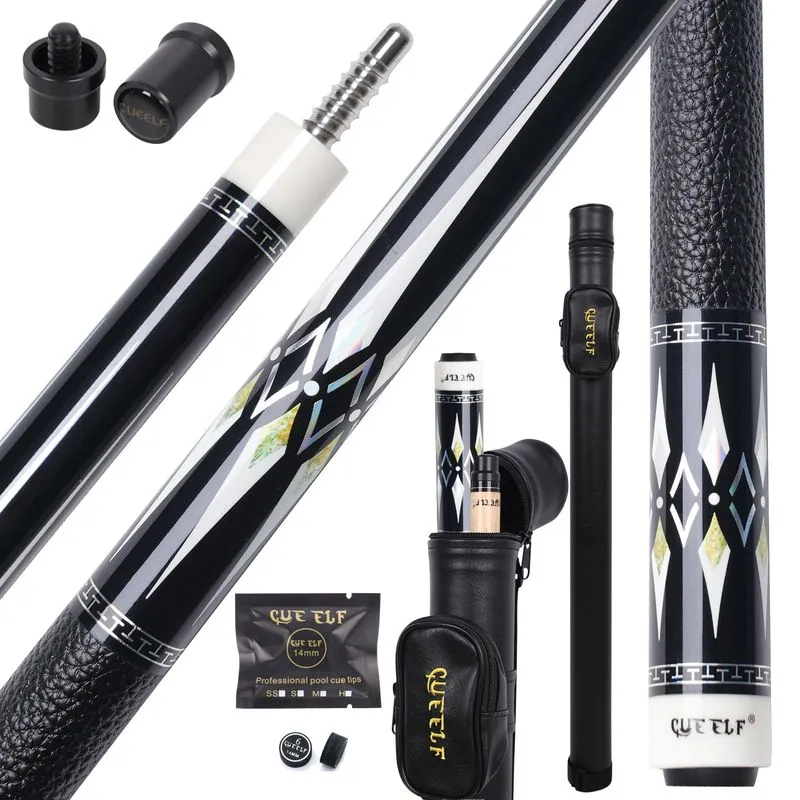
When you hit a ball with the CUEELF, you feel the vibration travel down the shaft and into the butt. For many players, this feedback is essential. It tells you exactly how well you struck the ball. If you mis-hit slightly, the wood lets you know. The CUESSIR, being carbon, can sometimes feel a bit "numb" or clinical in comparison. If you are a player who relies on feel and touch—perhaps you play a lot of one-pocket or straight pool—the CUEELF's wood shaft might speak to you more.
Hit Quality: CUESSIR Ascend vs CUEELF Professional
We touched on this above, but we need to go deeper. Hit quality is subjective, but it dictates how confident you feel over the ball.
The "Ping" vs. The "Thud"
The CUESSIR Ascend has that characteristic carbon fiber acoustic profile. It is a higher-pitched sound. Some players love it; it sounds like precision. Others find it hollow. In terms of vibration, the CUESSIR dampens the bad vibrations very well. You don't get that stinging sensation in your hand if you hit the ball off-center. The hit feels very "fast." The ball seems to pop off the tip with urgency.
The CUEELF Professional offers a more traditional "thud." It sounds solid and authoritative. Because it is a 2-piece wood cue with a stainless steel joint, the hit is firm but organic. The energy transfer feels slightly slower than the carbon, allowing you to feel like you are "holding" the ball on the tip for a fraction of a second longer. This is largely psychological, but it affects how you stroke the ball.
Tip Performance
Both cues come equipped with a 12.5mm tip. This is my preferred size for modern pool. It is smaller than the old-school 13mm (which can feel like a club) but larger than the 11.75mm shafts (which can be unforgiving).
The CUESSIR sports a 6-layer pigskin leather tip. Out of the box, I found this tip to be shaped nicely (roughly a nickel radius) and it held chalk well. It grabbed the cue ball effectively for draw shots.
The CUEELF also uses a 6-layer performance tip. Combined with the phenolic ferrule, the hit feels slightly harder than the CUESSIR. If you like a hard hit—similar to a break cue but with shooting control—the CUEELF setup is very satisfying.
Build Quality: CUESSIR Ascend vs CUEELF Professional
When we look at cues in the $100-$150 range, quality control is often the biggest concern. You want to ensure the cue rolls straight and the joint is secure.
The Radial Pin Connection
Both cues utilize a 3/8x8 Stainless Steel Radial Pin. I am thrilled to see this pin style becoming standard in this price bracket. The radial pin is widely considered one of the best joints in billiards. It offers a very tight wood-to-metal (or carbon-to-metal) lock.
Because the threads are wide and deep, they align the shaft and butt perfectly. This maximizes energy transfer. On both the CUESSIR and the CUEELF, the joints screwed together smoothly and tightened down with a reassuring lock. There was no buzzing or rattling on either cue during impact.
Finish and Aesthetics
The CUESSIR Ascend is striking. The 3K carbon weave pattern is visible and looks undeniably high-end. It catches the light and lets your opponents know you aren't playing with a house cue. The finish is satin-smooth, which is excellent for a closed bridge. However, carbon fiber is black. That's the look. If you want traditional points or inlays, you won't find them here.
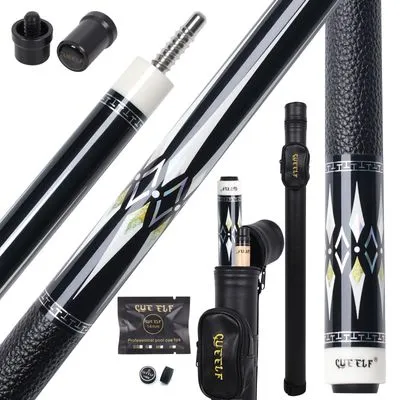
The CUEELF Professional takes a more classic approach. The wood grain is visible (depending on the specific stain model), and the overall finish is glossy on the butt sleeve. It looks like a traditional custom cue. The build feels substantial. However, being wood, it is susceptible to environmental changes. If you leave the CUEELF in a hot car, it can warp. The CUESSIR carbon shaft will never warp, regardless of temperature or humidity.
Grip and Ergonomics: Leather vs. Tech
Here is where the two cues diverge significantly in terms of player comfort.
CUEELF's Premium Leather Wrap
The CUEELF Professional justifies its higher price tag primarily through its grip. It features a premium leather wrap. For many players, myself included, nothing beats the feel of real leather. It manages hand sweat effectively, provides a moderate amount of traction without being sticky, and adds a layer of vibration dampening.
Holding the CUEELF feels luxurious. The leather has a texture that allows you to maintain a light grip on the cue without fear of it slipping during a power stroke. If you play in humid environments or have sweaty hands, this is a major factor.
CUESSIR's Sleek Handle
The CUESSIR Ascend generally follows the trend of "tech" cues, often utilizing a wrapless design or a textured finish directly on the butt material. While the description highlights the carbon weave, the lack of a designated wrap material like Irish linen or leather means you are gripping the finished surface of the cue.
For some, this provides the ultimate feedback. For others, it can feel slippery if your hands get clammy. The aesthetic is cleaner and more modern, but it lacks the tactile comfort of the CUEELF's leather.
Value and Versatility
We are looking at a $30 price difference, with the CUEELF being the more expensive option ($149.90 vs $119.99). Let's break down where that money goes.
At roughly $120, the CUESSIR Ascend is disrupting the market. Usually, carbon fiber shafts alone cost upwards of $300. To get a complete cue with a radial joint and a functional carbon shaft for this price is incredible. Furthermore, the CUESSIR comes with a protective carrying case. This is a huge value add.
The CUEELF is priced at roughly $150. You are paying for the leather grip and the extension compatibility. The ability to add an extension (sold separately usually) is a feature often found on much more expensive cues. It suggests that CUEELF views this product as a platform for a serious player.
Pros and Cons Summary
CUESSIR Ascend Carbon Fiber Pool Cue 58" - Pros & Cons
thumb_up Pros
- check_circle Unbeatable Value: One of the most affordable ways to get into carbon fiber.
- check_circle Low Deflection: 3K carbon shaft significantly improves accuracy on spin shots.
- check_circle Durability: Resistant to warping, dings, and temperature changes.
- check_circle Joint Quality: Radial pin provides a tight, pro-level connection.
- check_circle Included Case: Saves you $20-$30 immediately.
thumb_down Cons
- cancel Feedback: Can feel "hollow" or "dead" to players used to wood.
- cancel Grip: Lack of a wrap might be slippery for some.
- cancel Weight Bolts: Sold separately, making adjustment tricky out of the box.
CUEELF Professional Pool Cue 58" 20oz - Pros & Cons
thumb_up Pros
- check_circle Premium Feel: The leather grip is comfortable and manages moisture well.
- check_circle Classic Feedback: Wood shaft provides organic, lively vibration.
- check_circle Extension Ready: Designed to grow with your game (extension compatible).
- check_circle Aesthetics: Traditional, glossy look with high-quality finish.
- check_circle Ferrule: Phenolic ferrule adds durability and a solid hit.
thumb_down Cons
- cancel Maintenance: Wood requires more care to prevent warping.
- cancel Price: More expensive than the CUESSIR for "older" technology.
- cancel Deflection: Higher deflection than the carbon fiber competitor.
Final Verdict: CUESSIR Ascend or CUEELF Professional?
This comparison really comes down to what you are trying to achieve with your game right now.
Choose the CUESSIR Ascend Carbon Fiber if you are an improving player who wants to modernize their game. If you are struggling with missed shots when using english, the low deflection properties of this cue will help you immediately. It is also the perfect choice if you travel frequently, as the carbon fiber is virtually indestructible regarding warping.
Choose the CUEELF Professional if you are a purist who values the tactile experience of pool. If you hate the "clink" sound of carbon and want the warm, solid feedback of maple, this is your cue. The leather grip makes it a joy to hold for long practice sessions.
Personally? I would grab the CUESSIR Ascend. The performance benefits of carbon fiber—specifically the consistency and low deflection—are usually behind a $400 paywall. Getting that technology for $119 is an opportunity that is hard to pass up.
Will the carbon fiber shaft on the CUESSIR really improve my game? expand_more
Yes, but with a caveat. It won't make you pot balls you don't know how to aim. However, it will make your aim more consistent when using side spin (english) because the ball doesn't squirt off the line as much. It lowers the learning curve for advanced shots.
Can I change the tip on these cues? expand_more
Absolutely. Both cues use a standard 12.5mm tip size. When the installed pigskin tips eventually wear down, you can have any local cue smith install your preferred brand (like Kamui or Moori) without issue.
Is the CUEELF extension included in the price? expand_more
Typically, no. The cue is "extension compatible," which means the bumper is threaded to accept an extension, but you usually need to purchase the specific
Which cue is better for breaking? expand_more
While you can break with both, neither is a dedicated break cue. However, the