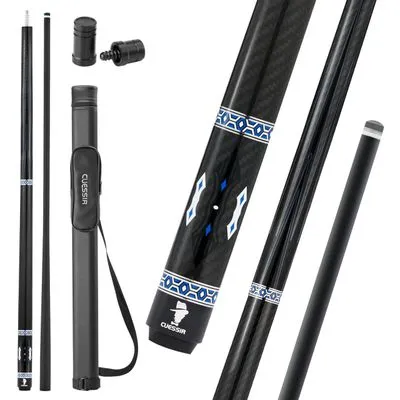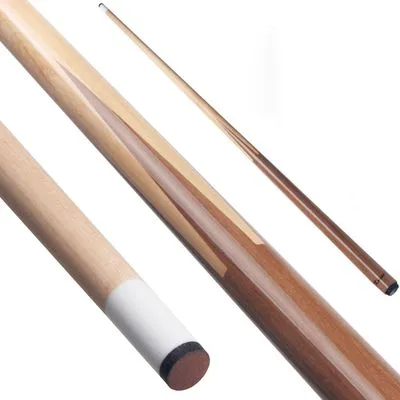
CUESSIR Ascend vs. Kmise Wooden Pool Cue: How Do the Specs Compare?
| Feature | ||
|---|---|---|
| Length | 58-inch (Standard Full Size) | 36-inch (Shorty/Junior) |
| Shaft Material | Aerospace-grade Carbon Fiber | Maple and Maraschi Wood |
| Tip Size | 12.5mm | 13mm |
| Tip Type | 6-layer Pigskin Leather | Standard Precision Tip |
| Joint Type | Stainless Steel Radial Pin | One-Piece (No Joint) |
| Taper | Pro Taper | Standard Conical |
| Best For | Intermediate/Competitive Play | Tight Spaces, Kids, Home Tables |
| Price | ~$119.99 | ~$29.99 |
CUESSIR Ascend Carbon Fiber vs. Kmise Wooden Cue: Which Shaft Construction Provides Better Deflection Control?
Comparing the
Because the shaft is hollow or foam-filled, the end mass is significantly lower. This relates directly to deflection, or \"squirt.\" Applying English (side spin) with the CUESSIR causes less cue ball push-off than traditional maple shafts.
How does shaft length affect deflection on the Kmise Wooden Pool Cue?
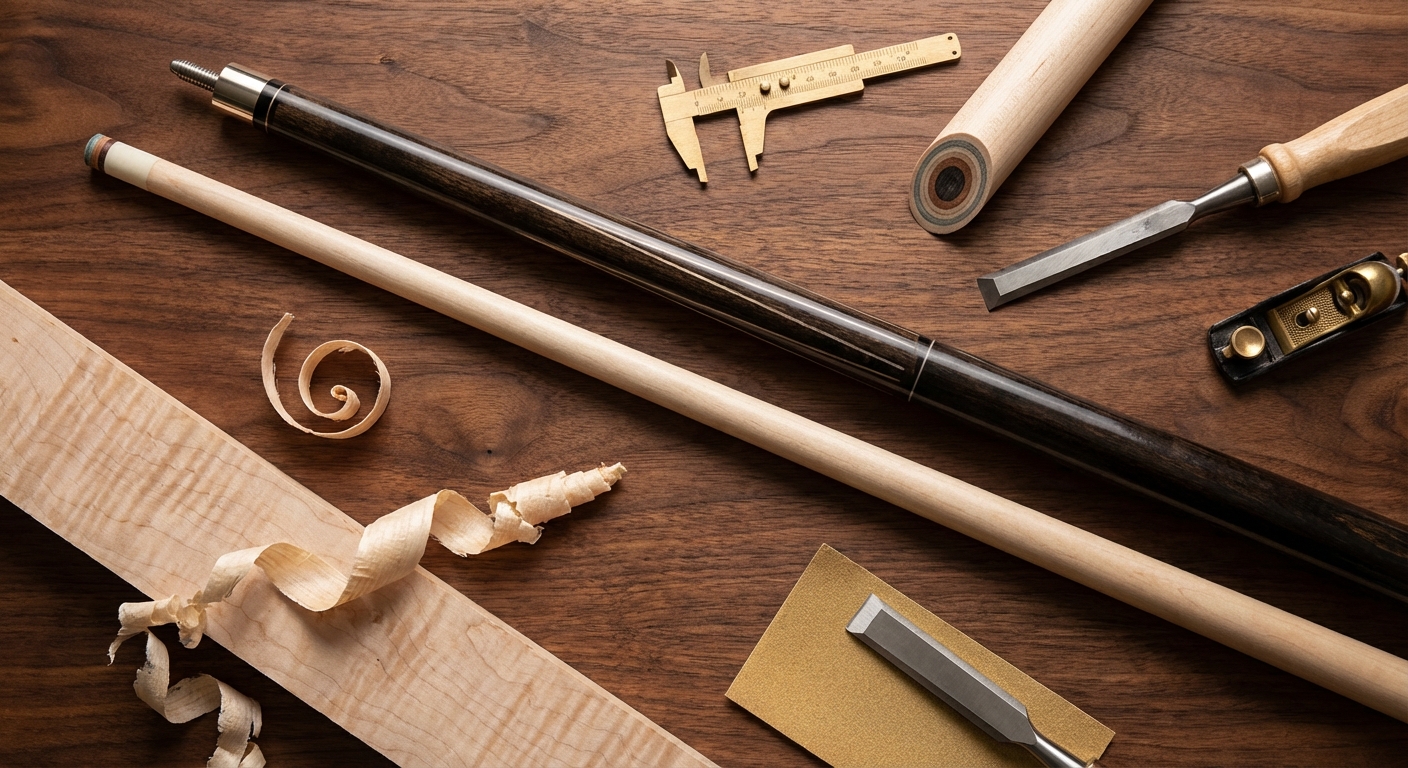
The Kmise Wooden Pool Cue is unique because it is only 36 inches long. While it is made of Maple and Maraschi wood, the short length changes the physics.
A shorter lever arm naturally flexes less. However, lacking the CUESSIR's \"Pro Taper,\" the shaft thickens quickly as you move back from the tip.
The CUESSIR features a 12.5mm tip with a long, consistent pro taper. This allows the shaft to glide through your bridge fingers without rising. The Kmise sports a stout 13mm tip. This thicker tip offers a large surface area for beginners but lacks the CUESSIR’s surgical precision.
CUESSIR Ascend Radial Pin vs. Kmise One-Piece: How do the Joint Types Affect Hit Feedback?
The connection point of a cue defines how the hit feels. The CUESSIR Ascend uses a stainless steel radial pin. In my years on the tournament floor, I’ve found radial pins offer extremely solid lock-ups.
Because the threads are deep, the surface area contact between the butt and the shaft is maximized. When you strike the cue ball, the feedback is immediate. Carbon fiber provides a high-pitched \"ping,\" and the radial pin amplifies this stiff, precise sensation.
How Solid is the One-Piece Design of the Kmise Wooden Pool Cue?
In contrast, the Kmise Wooden Pool Cue is a one-piece construction. It does not have a joint. While usually relegated to \"house cue\" status, there is an inherent advantage to this design: integrity.There are no screws to loosen and no joint collars to crack. The hit feedback on the Kmise is surprisingly solid because the energy travels through a single piece of wood.
However, it lacks the CUESSIR's sophisticated feedback. The Kmise hit feels more \"thud-like\" or dead. This is due to wood density and the rubber bumper. It lacks the carbon fiber's liveliness. Yet, it feels robust enough to handle aggressive break shots in tight spaces.
CUESSIR Ascend 3K Weave vs. Kmise Varnish Finish: Which Pool Cue Grip Is More Comfortable?
Grip is where you connect with the instrument. The CUESSIR Ascend showcases a stunning 3K carbon fiber weave on the butt. It relies on the texture of the finish rather than a wrap.
Carbon fiber finishes can feel slick to sweaty hands. However, the 3K weave offers enough texture for a confident grip. The CUESSIR's balance point is adjustable, allowing you to fine-tune how the grip feels during the stroke.
What are the Handling Characteristics of the Kmise Wooden Pool Cue High-Gloss Finish?
The Kmise Wooden Pool Cue features a high-gloss varnish finish. This is the classic \"house cue\" feel. It looks clean and protects the wood from warping.However, heavy varnish can get sticky. In humid basements, the Kmise might create friction on your bridge hand or feel tacky in your grip.
Does the lack of a wrap affect the performance of the Kmise Wooden Pool Cue?
CUESSIR Ascend vs. Kmise Wooden Cue: Which Pool Cue Offers the Best Price-to-Performance Ratio?
Analyzing value here requires looking at the intended use. The CUESSIR Ascend Carbon Fiber Pool Cue comes in around $119.99. This is an aggressive entry price for carbon fiber.
Most big-name carbon shafts alone cost upwards of $400. To get a complete, low-deflection cue with a radial pin for under $150 is exceptional value. It bridges the gap between intermediate play and professional gear.
What is the Primary Utility Value of the Kmise 36-Inch Wooden Pool Cue?
The Kmise Wooden Pool Cue sits at roughly $29.99. You cannot expect high-performance mechanics at this price, but that isn't its job. Its job is to fit where a 58-inch cue cannot.If you have a pool table in a smaller room, you essentially must own a cue like the Kmise. A 58-inch cue is useless if you can't draw it back without hitting the drywall.
Therefore, the Kmise offers high \"situational value.\" It solves a specific problem cheaply. It includes a functional 13mm tip that holds chalk reasonably well, making it a reliable backup.
Which Pool Cue Offers Better Longevity: CUESSIR Ascend or Kmise Wooden Cue?
The CUESSIR Ascend wins on durability. Carbon fiber does not warp, ding, or react to temperature changes. You could leave the CUESSIR in a cold car, and it would likely stay straight.The Kmise, being wood, is susceptible to warping over time. However, at $30, replacing the Kmise every few years is less painful than replacing a primary playing cue.
If you are serious about improving your game, the CUESSIR is an investment. If you must protect your drywall during a home game, the Kmise is the best money you can spend.
Can I add weight bolts to the Kmise cue? expand_more
No, the Kmise is a one-piece wooden stick with a fixed weight. The CUESSIR Ascend, however, does feature an adjustable weight system if you purchase the bolts separately.
Is the Kmise cue suitable for breaking? expand_more
The Kmise is solid and handles break shots in tight spaces well. You should spare your precision CUESSIR tip from heavy breaks.